
Note
Go to the end to download the full example code.
vmap parameter sweeps: the same Kuramoto transition, one XLA call#
05_kuramoto_sync.py swept
the coupling strength G with a plain
Python for loop, one full lyapunov_spectrum call per G value.
lyapax.sweep.sweep_lyapunov_spectrum does the same sweep as a single
jax.vmap-batched call instead – one XLA program that computes every
grid point together, rather than len(G_values) separate Python-level
dispatches (each of which re-enters the JAX/XLA call machinery even when,
as
07_speed_and_accuracy.py
found, the compiled executable itself
is cached across same-shape calls).
Why sweeping needs a different step function. jax.vmap can only
batch over things passed to it as data, not over values baked into a
closure at construction time – and both network_problem and the
lower-level make_network_step_fn it wraps close params (e.g. the
coupling strength G) over when the step is built, exactly like the
non-swept examples use it. network_step_parametrized is the same
Network-based wiring with params taken as a call-time argument
instead (step(state, params) -> new_state), so a batch of params
values can be threaded through a single jax.vmap call around the
existing, unmodified lyapunov_spectrum – no new tangent-propagation
or QR code needed, since batching a computation is orthogonal to what the
computation itself does.
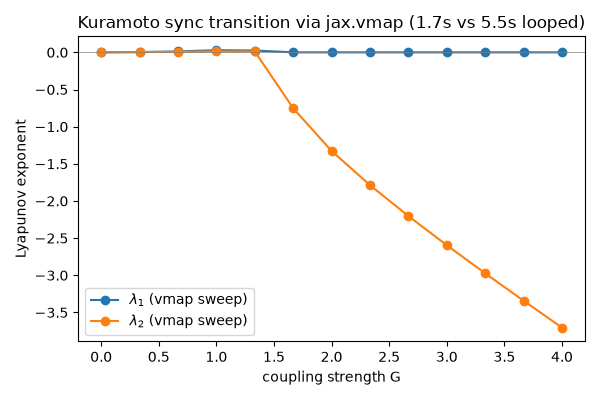
Correctness, not just speed. The plot below reproduces 05_kuramoto_sync.py’s figure using the vmap sweep instead of the Python loop; the values are compared point-by-point against a fresh Python-loop run of the exact same system below and printed as a max-abs-diff (should be at or near machine precision – this is the same computation, just batched).
import os

os.environ["JAX_PLATFORMS"] = "cpu"
import time

import jax
import jax.numpy as jnp
import matplotlib.pyplot as plt
import numpy as np

jax.config.update("jax_enable_x64", True)

from lyapax.core import lyapunov_spectrum
from lyapax.coupling import kuramoto_coupling
from lyapax.network import Network, network_problem, network_step_parametrized
from lyapax.simulator import ModelSpec, Parameter, StateVar, build_jax_dfun
from lyapax.sweep import sweep_lyapunov_spectrum
n_nodes = 6
omega = jnp.linspace(-1.0, 1.0, n_nodes)
weights = jnp.ones((n_nodes, n_nodes)) - jnp.eye(n_nodes)

model = ModelSpec(
    name="kuramoto",
    state_variables=(StateVar("theta", default_init=0.0),),
    parameters=(Parameter("omega", 0.0),),
    cvar=("theta",),
    dfun_str={"theta": "omega + c"},
)
dfun = build_jax_dfun(model)
network = Network(weights=weights, cvar_indices=model.cvar_indices)

dt = 1e-2
state0 = jnp.linspace(0.0, 2 * jnp.pi, n_nodes, endpoint=False)
G_values = jnp.linspace(0.0, 4.0, 13)
n_sweep = G_values.shape[0]

sweep_kwargs = dict(dt=dt, n_steps=5_000, renorm_every=10, k=2, t_transient=50.0)
— one vmap-batched call over the whole G grid —
step_p = network_step_parametrized(
    dfun, network, kuramoto_coupling(alpha=0.0), dt)
params_batch = {
    "omega": jnp.broadcast_to(omega, (n_sweep, n_nodes)),
    "G": G_values,
}

t0 = time.perf_counter()
swept = sweep_lyapunov_spectrum(step_p, state0, params_batch, **sweep_kwargs)
jax.block_until_ready(swept)
t_vmap = time.perf_counter() - t0
print(f"vmap sweep ({n_sweep} points): {t_vmap:.2f}s")
vmap sweep (13 points): 1.75s
— reference: the 05_kuramoto_sync.py Python loop, same system, same G values —
loop_kwargs = {k: v for k, v in sweep_kwargs.items() if k != "dt"}
t0 = time.perf_counter()
lambda1_loop, lambda2_loop = [], []
for G in G_values:
    params = {"omega": omega, "G": float(G)}
    problem = network_problem(
        dfun, network, kuramoto_coupling(alpha=0.0),
        params=params, state0=state0, dt=dt,
    )
    result = lyapunov_spectrum(problem, **loop_kwargs)
    lambda1_loop.append(float(result.exponents[0]))
    lambda2_loop.append(float(result.exponents[1]))
t_loop = time.perf_counter() - t0
print(f"Python loop ({n_sweep} points): {t_loop:.2f}s  ({t_loop / t_vmap:.1f}x slower than vmap)")

lambda1_swept = np.array(swept.exponents[:, 0])
lambda2_swept = np.array(swept.exponents[:, 1])
max_diff = max(
    np.max(np.abs(lambda1_swept - np.array(lambda1_loop))),
    np.max(np.abs(lambda2_swept - np.array(lambda2_loop))),
)
print(f"max |vmap - loop| over the whole grid: {max_diff:.2e} (same computation, just batched)")
Python loop (13 points): 5.54s  (3.2x slower than vmap)
max |vmap - loop| over the whole grid: 3.20e-14 (same computation, just batched)
fig, ax = plt.subplots(figsize=(6, 4))
ax.plot(G_values, lambda1_swept, "o-", label=r"$\lambda_1$ (vmap sweep)")
ax.plot(G_values, lambda2_swept, "o-", label=r"$\lambda_2$ (vmap sweep)")
ax.axhline(0.0, color="gray", lw=0.5)
ax.set_xlabel("coupling strength G")
ax.set_ylabel("Lyapunov exponent")
ax.set_title(f"Kuramoto sync transition via jax.vmap ({t_vmap:.1f}s vs {t_loop:.1f}s looped)")
ax.legend()
fig.tight_layout()
plt.show()
Total running time of the script: (0 minutes 7.540 seconds)