Examples#
Runnable demos of lyapax’s Lyapunov-exponent engine, in
sphinx-gallery format (each file is
plain, directly-runnable Python, and also renders into the docs gallery –
see docs/).
Demos cover: inspecting a model’s raw simulated time series as a sanity
check before computing exponents (single systems and coupled networks
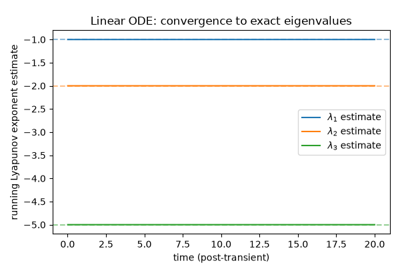
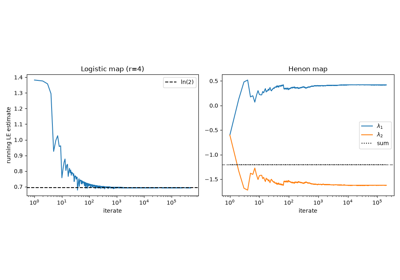
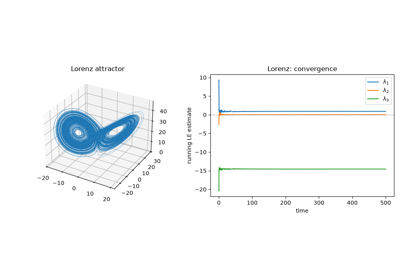
alike), benchmark systems with a known answer (Tiers 0-2 of
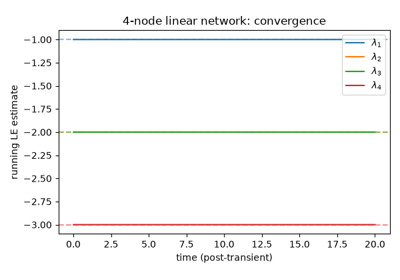
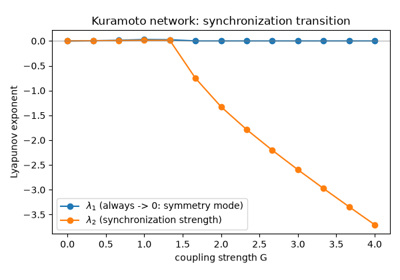
Validation: how lyapax’s results are checked), coupled networks (Tier 3), the extensibility
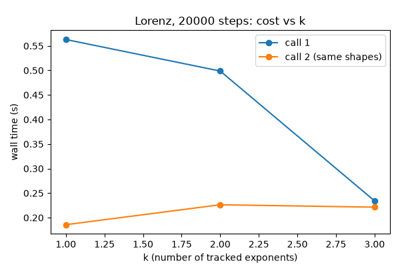
of custom coupling functions, a speed/accuracy characterization of the
current implementation (including RK4 vs RK6 convergence-order slopes),
delayed (DDE) networks – both a per-edge linear
delay sweep against a closed-form (Lambert W) reference and a delayed
Kuramoto network showing what transmission delay does to synchronization
(Tier 4-5) – a matrix-free (jvp/vmap) tangent-propagation speedup on
a large network, a jax.vmap parameter-sweep helper (one batched call
reproducing an earlier Python-loop G-sweep, faster and bit-for-bit
identical), the public front door (ode_problem, Network/
network_problem, dde_problem/network_dde_problem) that gives
plain, coupled, and delayed systems the same dynamics/network/coupling/
integrator/problem construction recipe, with state0/dt given once,
and grid-snapped vs. Hermite-interpolated DDE history reads
(interpolate=True) compared against a closed-form (Lambert W)
reference, showing why the latter converges smoothly as dt shrinks
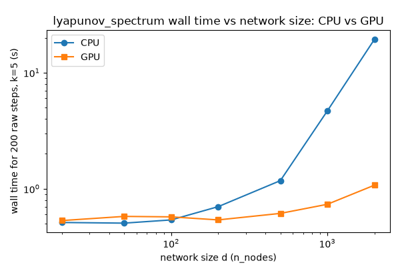
and the former does not – and a CPU-vs-GPU wall-time comparison across
growing network size, showing that lyapax’s GPU support only pays off
once the per-step arithmetic is large enough to amortize a GPU’s fixed
kernel-launch/transfer overhead, with the crossover point measured rather
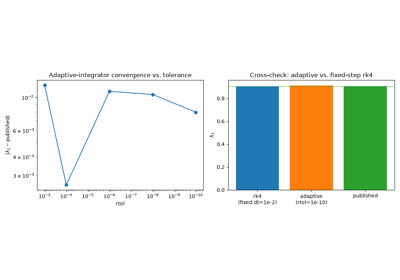
than asserted – and an adaptive-step ODE integrator
(lyapax.adaptive.diffrax_adaptive_step, backed by diffrax) that decouples
the renormalization sampling interval from the integrator’s own internal
step size, with a tolerance-convergence sweep, a cross-check against
fixed-step rk4, and a demonstration that differentiating a Lyapunov exponent
through it requires jax.jacfwd rather than jax.grad – and a
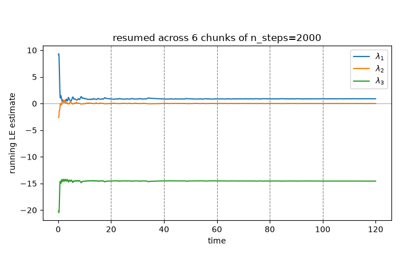
convergence diagnostic (lyapax.core.convergence_drift) that summarizes
how much a run’s running exponent estimate moved over the tail of the run,
paired with result.checkpoint/lyapunov_spectrum(..., resume=...),
which continues a fixed-n_steps run from where it left off instead of
restarting, letting a caller run in inspectable chunks and stop once
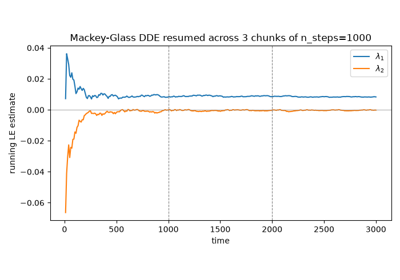
convergence_drift says the estimate has settled – and the same
run-inspect-resume loop for a DDE (lyapax.dde.lyapunov_spectrum_dde(...,
resume=...) / lyapax.dde.DDECheckpoint) on the Mackey-Glass chaotic
benchmark, showing that a DDE checkpoint must additionally carry the delay
ring buffer’s state (not just trajectory state and tangent basis) for a
resumed run to continue correctly – and differentiating a Lyapunov
exponent w.r.t. a system parameter with jax.grad/jax.jacfwd,
demonstrating gradient-based tuning of a parameter toward a target
exponent on a non-chaotic system, then measuring how the same gradient
becomes numerically meaningless (grows by many orders of magnitude with
trajectory length rather than converging) once the underlying system is
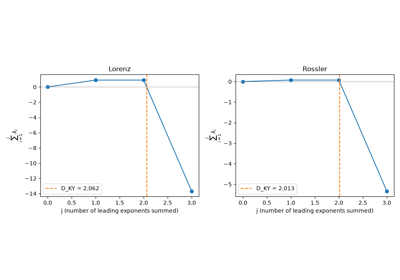
genuinely chaotic – and the Kaplan-Yorke (Lyapunov) dimension
(lyapax.core.kaplan_yorke_dimension), a pure post-processing readout
of an existing Lyapunov spectrum, computed for Lorenz and Rossler and
matching published values, with the cumulative-sum-crossing-zero mechanics
behind the formula plotted directly and the partial-spectrum guard
(d_total=) shown raising instead of silently understating the
dimension.
New capability -> new demo: as engine features land (a new coupling kind, a new delay structure, a performance change, …), add a runnable example that exercises it, not just unit-test coverage.
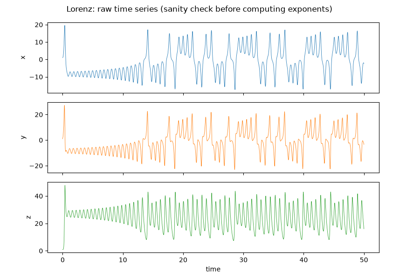
Sanity check: watch the time series before trusting the exponents
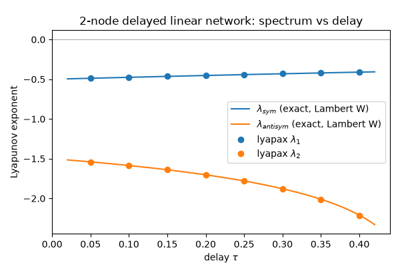
Delayed coupling: two-node linear DDE network vs delay
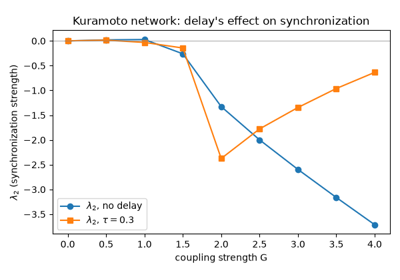
Kuramoto network with delayed coupling: what transmission delay does
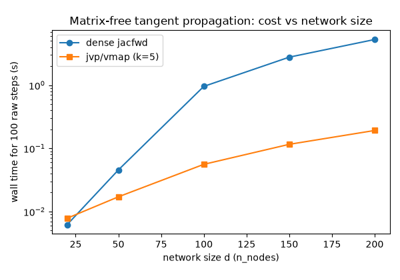
Matrix-free tangent propagation: dense jacfwd vs jvp/vmap
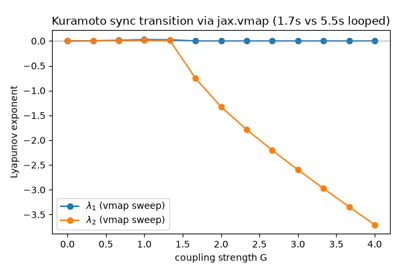
vmap parameter sweeps: the same Kuramoto transition, one XLA call
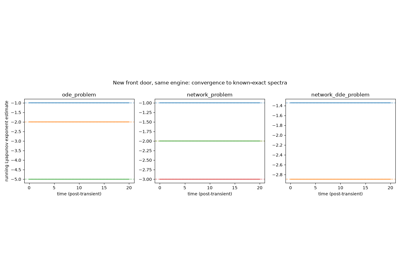
The lyapax front door: problem objects for ODEs, networks, and DDEs
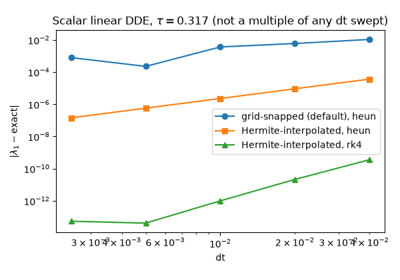
DDE history reads: grid-snapped vs Hermite-interpolated
Convergence diagnostics: convergence_drift + resume
Resuming a DDE run: convergence_drift + resume, ring-buffer edition
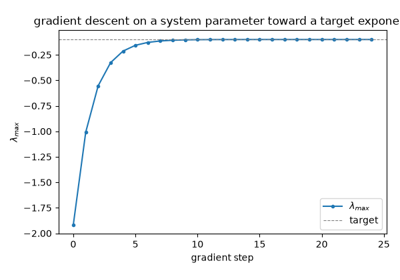
Differentiating a Lyapunov exponent w.r.t. a system parameter