
Note
Go to the end to download the full example code.
Adaptive-step ODE integration (diffrax)#
Every other ODE example uses a fixed-step integrator ("rk4", "rk6",
…): the same dt is both the sampling interval between QR
renormalizations and the integrator’s own internal step size, so getting
a smaller local truncation error means shrinking dt globally, which also
means more (cheap) raw steps between renormalizations.
lyapax.adaptive.diffrax_adaptive_step decouples those two meanings of
dt. It builds an integrator, backed by diffrax, whose internal step size is chosen
adaptively (via a PID step-size controller and an embedded Runge-Kutta error
estimate) to hit a requested local error tolerance – while dt itself
keeps meaning only “the interval between renormalizations”. It drops
straight into lyapax.ode_problem alongside the fixed-step builtins, with
no other code changes: lyapunov_spectrum cannot tell the difference
between an integrator that takes one internal step per call and one that
takes an internally-controlled, variable number of them.
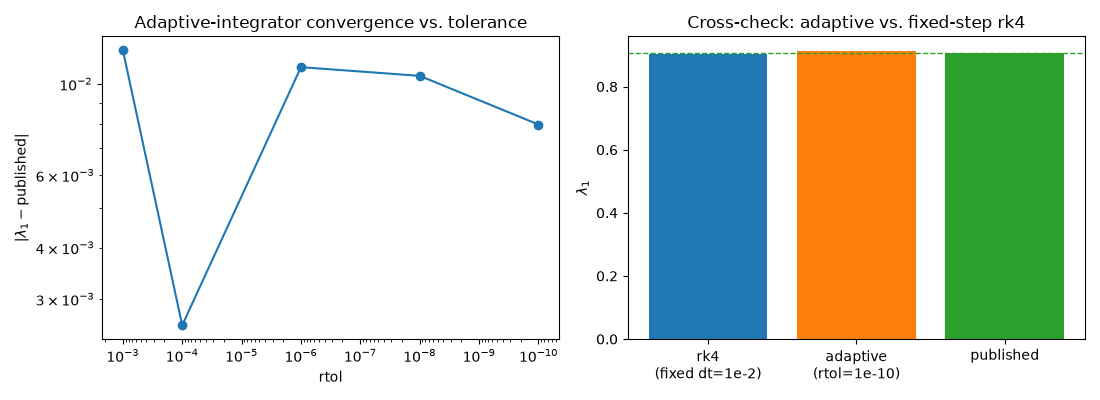
Reading the plot. The left panel sweeps the controller’s tolerance
(rtol, with atol scaled alongside it) and shows the Lyapunov
exponent estimate converging toward the published Lorenz value as the
tolerance tightens – the adaptive analogue of a dt-convergence sweep.
The right panel cross-checks the tightest-tolerance adaptive estimate
against a fine-dt fixed-step rk4 run of the same system: both should
agree with each other and with the published value, confirming the adaptive
path is solving the same problem, not just converging to something.
A real caveat. The adaptive integrator’s internal accept/reject/step
-size loop is a jax.lax.while_loop with a data-dependent trip count.
Forward-mode differentiation (jax.jvp/jax.jacfwd) works through it
fine – that’s what the Lyapunov engine’s own tangent propagation already
uses. Reverse-mode (jax.grad/jax.jacrev) does not: JAX cannot
replay a dynamic-trip-count while_loop backward. The last section below
demonstrates differentiating a Lyapunov exponent with respect to a system
parameter using jax.jacfwd (which works and matches finite differences)
and shows jax.grad raising instead of silently returning something
wrong.
import os

os.environ["JAX_PLATFORMS"] = "cpu"

import jax
import jax.numpy as jnp
import matplotlib.pyplot as plt

jax.config.update("jax_enable_x64", True)

from lyapax import lyapunov_spectrum, ode_problem, systems
from lyapax.adaptive import diffrax_adaptive_step
from lyapax.integrators import rk4_step
sigma, rho, beta = 10.0, 28.0, 8.0 / 3.0
rhs = systems.lorenz(sigma, rho, beta)
state0 = jnp.array([1.0, 1.0, 1.0])
published_lambda1 = 0.9056

rtols = [1e-3, 1e-4, 1e-6, 1e-8, 1e-10]
errors = []
for rtol in rtols:
    integrator = diffrax_adaptive_step(rtol=rtol, atol=rtol * 1e-2)
    problem = ode_problem(rhs, state0=state0, dt=0.1, integrator=integrator)
    result = lyapunov_spectrum(
        problem, n_steps=5_000, renorm_every=1, t_transient=100.0)
    errors.append(abs(float(result.exponents[0]) - published_lambda1))
    print(f"rtol={rtol:.0e}  lambda1={float(result.exponents[0]):.4f}  "
          f"error={errors[-1]:.2e}")
rtol=1e-03  lambda1=0.8935  error=1.21e-02
rtol=1e-04  lambda1=0.9030  error=2.59e-03
rtol=1e-06  lambda1=0.8946  error=1.10e-02
rtol=1e-08  lambda1=0.9161  error=1.05e-02
rtol=1e-10  lambda1=0.9136  error=7.97e-03
Cross-check: tightest-tolerance adaptive run vs. a fine-dt fixed-step rk4 run of the same system.
rk4_problem = ode_problem(rhs, state0=state0, dt=1e-2, integrator=rk4_step)
rk4_result = lyapunov_spectrum(
    rk4_problem, n_steps=50_000, renorm_every=10, t_transient=100.0)

tight_integrator = diffrax_adaptive_step(rtol=1e-10, atol=1e-12)
adaptive_problem = ode_problem(rhs, state0=state0, dt=0.1, integrator=tight_integrator)
adaptive_result = lyapunov_spectrum(
    adaptive_problem, n_steps=5_000, renorm_every=1, t_transient=100.0)

print(f"\nrk4 (dt=1e-2):      lambda1={float(rk4_result.exponents[0]):.4f}")
print(f"adaptive (rtol=1e-10): lambda1={float(adaptive_result.exponents[0]):.4f}")
print(f"published:          lambda1={published_lambda1:.4f}")
rk4 (dt=1e-2):      lambda1=0.9017
adaptive (rtol=1e-10): lambda1=0.9136
published:          lambda1=0.9056
fig, (ax1, ax2) = plt.subplots(1, 2, figsize=(11, 4))

ax1.loglog(rtols, errors, "o-")
ax1.set_xlabel("rtol")
ax1.set_ylabel(r"$|\lambda_1 - \mathrm{published}|$")
ax1.set_title("Adaptive-integrator convergence vs. tolerance")
ax1.invert_xaxis()

methods = ["rk4\n(fixed dt=1e-2)", "adaptive\n(rtol=1e-10)", "published"]
values = [float(rk4_result.exponents[0]), float(adaptive_result.exponents[0]),
          published_lambda1]
ax2.bar(methods, values, color=["C0", "C1", "C2"])
ax2.axhline(published_lambda1, color="C2", linestyle="--", linewidth=1)
ax2.set_ylabel(r"$\lambda_1$")
ax2.set_title("Cross-check: adaptive vs. fixed-step rk4")
fig.tight_layout()
plt.show()
Differentiating a Lyapunov exponent through the adaptive integrator: works with jax.jacfwd (forward-mode), not with jax.grad (reverse-mode).
def lambda_max(rho_param):
    def linear_rhs(y):
        # A small linear system whose exact fundamental matrix (and hence
        # exact Lyapunov exponent, its log-growth rate) is known, so the
        # jacfwd result can be checked against a closed-form derivative
        # rather than only a finite-difference estimate.
        return jnp.array([[-rho_param, 1.0], [-1.0, -rho_param]]) @ y

    integrator = diffrax_adaptive_step(rtol=1e-8, atol=1e-10)
    problem = ode_problem(linear_rhs, state0=jnp.array([1.0, 0.3]), dt=0.2,
                           integrator=integrator)
    result = lyapunov_spectrum(problem, n_steps=50, renorm_every=1, k=1)
    return result.exponents[0]


a0 = 0.5
grad_fwd = jax.jacfwd(lambda_max)(a0)
eps = 1e-5
finite_diff = (lambda_max(a0 + eps) - lambda_max(a0 - eps)) / (2 * eps)
print(f"\njax.jacfwd(lambda_max)({a0}) = {float(grad_fwd):.6f}")
print(f"finite-difference reference   = {float(finite_diff):.6f}")

try:
    jax.grad(lambda_max)(a0)
except ValueError as exc:
    print(f"\njax.grad raises (expected): {type(exc).__name__}: "
          f"{str(exc)[:88]}...")
jax.jacfwd(lambda_max)(0.5) = -1.000000
finite-difference reference   = -1.000000

jax.grad raises (expected): ValueError: Reverse-mode differentiation does not work for lax.while_loop or lax.fori_loop with dyna...
Total running time of the script: (0 minutes 22.149 seconds)